

Compassion is the very heart of Buddhism — and no figure embodies it more completely than Avalokiteshvara, the Bodhisattva of Compassion. Known as Chenrezig in Tibetan, Guanyin in Chinese, and Kannon in Japanese, Avalokiteshvara represents the compassion of all the Buddhas in a single form. His mantra — Om Mani Padme Hum — is the most widely recited in all of Buddhism. His statues are found in monasteries, temples, and home altars in every country where Buddhism has taken root.
The story of Avalokiteshvara statues is one of Buddhism’s most fascinating evolutionary journeys. As the Dharma traveled eastward from India through Tibet, Central Asia, China, Korea, and Japan, the embodiment of compassion adapted — taking on different names, genders, forms, and cultural characteristics — yet always retaining the essential quality of boundless compassion for all sentient beings. The result is a family of statues more diverse than any other in the Buddhist pantheon.
This complete guide covers the Avalokiteshvara meaning, the rich Chenrezig symbolism, the full explanation of the Om Mani Padme Hum mantra, and every major cultural variation of Avalokiteshvara statues — from the four-armed Tibetan Chenrezig to the 1000-armed form, the feminine Guanyin, and the masculine Lokesvara of Cambodia.
Contents
- Cultural Variations of Avalokiteshvara Statues
- Buddhist Mandate of Avalokiteshvara
- 1000 Armed Avalokiteshvara — The Story
- Avalokiteshvara in Tibetan Buddhism — Chenrezig
- Om Mani Padme Hum — The Chenrezig Mantra
- Om Mani Padme Hum Meaning Explained
- Masculine Origin of Avalokiteshvara
- Male Avalokiteshvara Statues — Theravada & Cambodia
- Female Avalokiteshvara — Guanyin in East Asia
- Special Attributes of Guanyin Statues
- Taoist Influence on Guanyin Statues in China
- Frequently Asked Questions About Avalokiteshvara
Cultural Variations of Avalokiteshvara Statues
In East Asia and Tibet, compassion was culturally perceived in different ways — and Avalokiteshvara statues reflect this diversity. A universal virtue such as compassion is not as uniformly perceived as one might assume. As Buddhism traveled across different civilizations, each culture imposed its own physical and symbolic characteristics onto the embodiment of compassion — resulting in one of the most visually varied deity traditions in all of Buddhist art.
These cultural variations sometimes resulted in Avalokiteshvara statues with superhuman features. The changes were both masculine and feminine: in Tibet the cultural adaptation of Avalokiteshvara was male (Chenrezig), while in East Asia Avalokiteshvara became an elegant female (Guanyin). However, both traditions also embraced the superhuman forms — particularly the 1000-armed, 11-headed Avalokiteshvara, which is venerated across every Buddhist culture as the supreme expression of compassion in action.
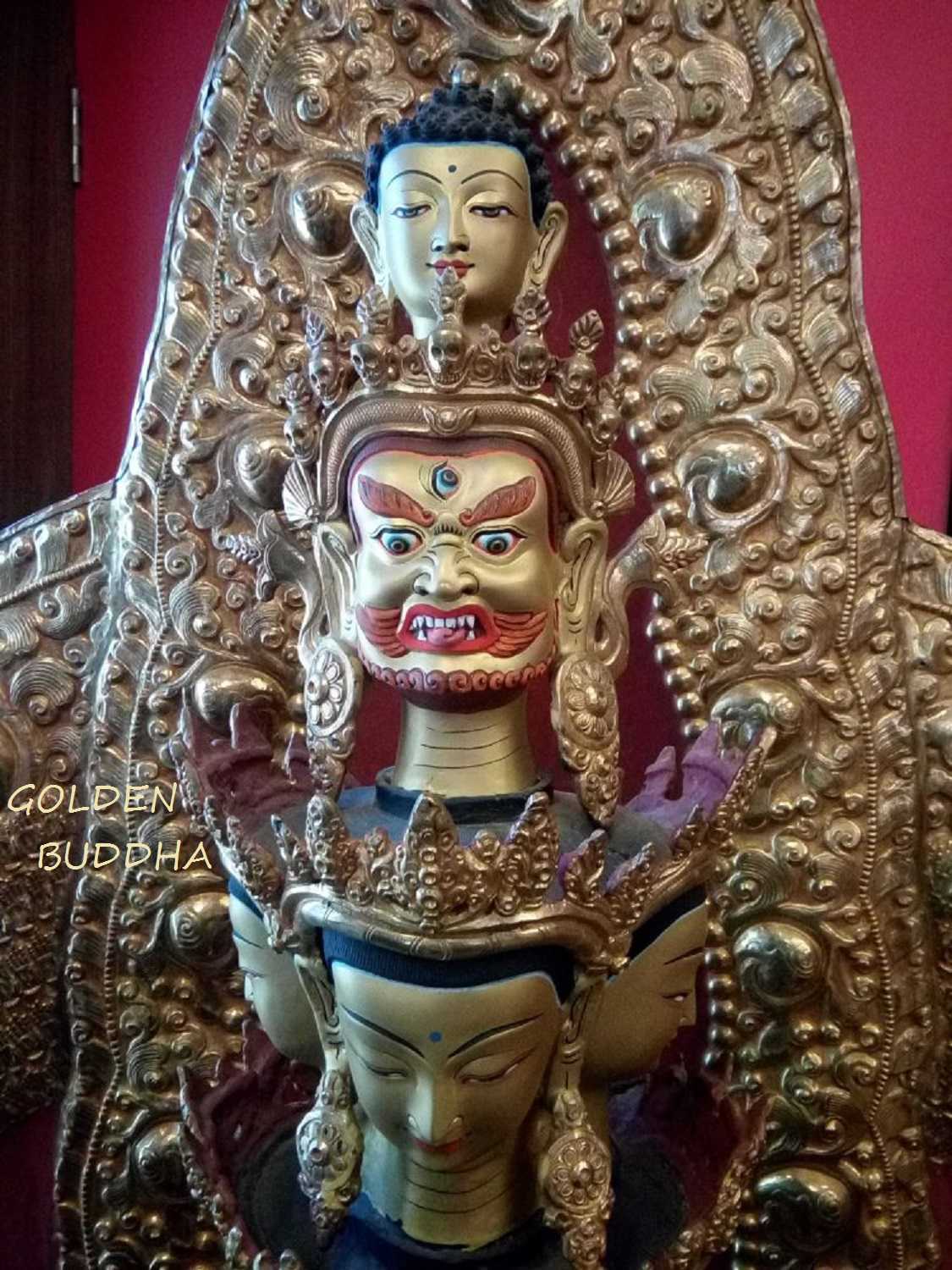
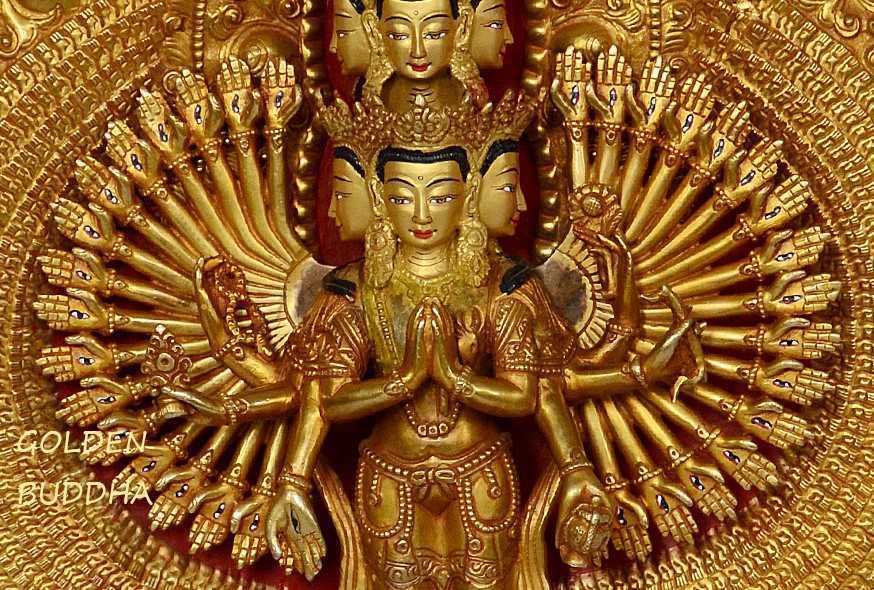
1000 Armed Avalokiteshvara Statue with 11 Heads

Buddhist Mandate of Avalokiteshvara
The Buddhist canon states that “Bodhisattvas can assume whatever gender and form is necessary to liberate beings from ignorance and dukkha (suffering).” This principle — known as upaya or “skillful means” — is the theological foundation for the extraordinary diversity of Avalokiteshvara’s forms. The different manifestations of Avalokiteshvara are not contradictions; they are deliberate adaptations designed to make compassion maximally accessible across different cultures, genders, and temperaments.
Avalokiteshvara made a solemn vow — one of the most profound in all of Buddhist teaching — to remain in samsara (the cycle of rebirth) until every last sentient being has been liberated from suffering. He declared he would not enter final Nirvana while even one being remained in pain. The immensity of this vow — encompassing all beings across all world systems and all eons of time — is precisely what demanded superhuman form. No ordinary human body could carry out such a commitment.
1000 Armed Avalokiteshvara — The Story
The story behind the 1000 armed Avalokiteshvara is one of the most moving narratives in all of Buddhist literature. Avalokiteshvara toiled night and day to assist all sentient life — liberating beings from the lower realms, guiding them toward enlightenment, and relieving every form of suffering. However, he soon discovered that many of the beings he had liberated had returned to their old destructive patterns, sinking back into suffering. Confronted with the seemingly inexhaustible ignorance of sentient life and the enormity of his vow, the body of Avalokiteshvara imploded into thousands of pieces.
Amitabha Buddha — of whom Avalokiteshvara is a spiritual emanation — arrived and reassembled him. But Amitabha did not simply restore the original form. Understanding the immensity of the challenge, he granted Avalokiteshvara a supremely empowered new body — 1000 arms and 11 heads — so he could work with maximum effectiveness across all directions and dimensions simultaneously.
The 11 heads of the Avalokiteshvara statue are arranged in a specific order with profound meaning: Amitabha placed his own head on top — personally overseeing all activity. Directly below Amitabha is the head of Vajrapani (embodying the Buddha’s power), and the nine lower heads are Avalokiteshvara’s own — representing his capacity to perceive suffering in every direction and every realm.
11 Heads of Avalokiteshvara
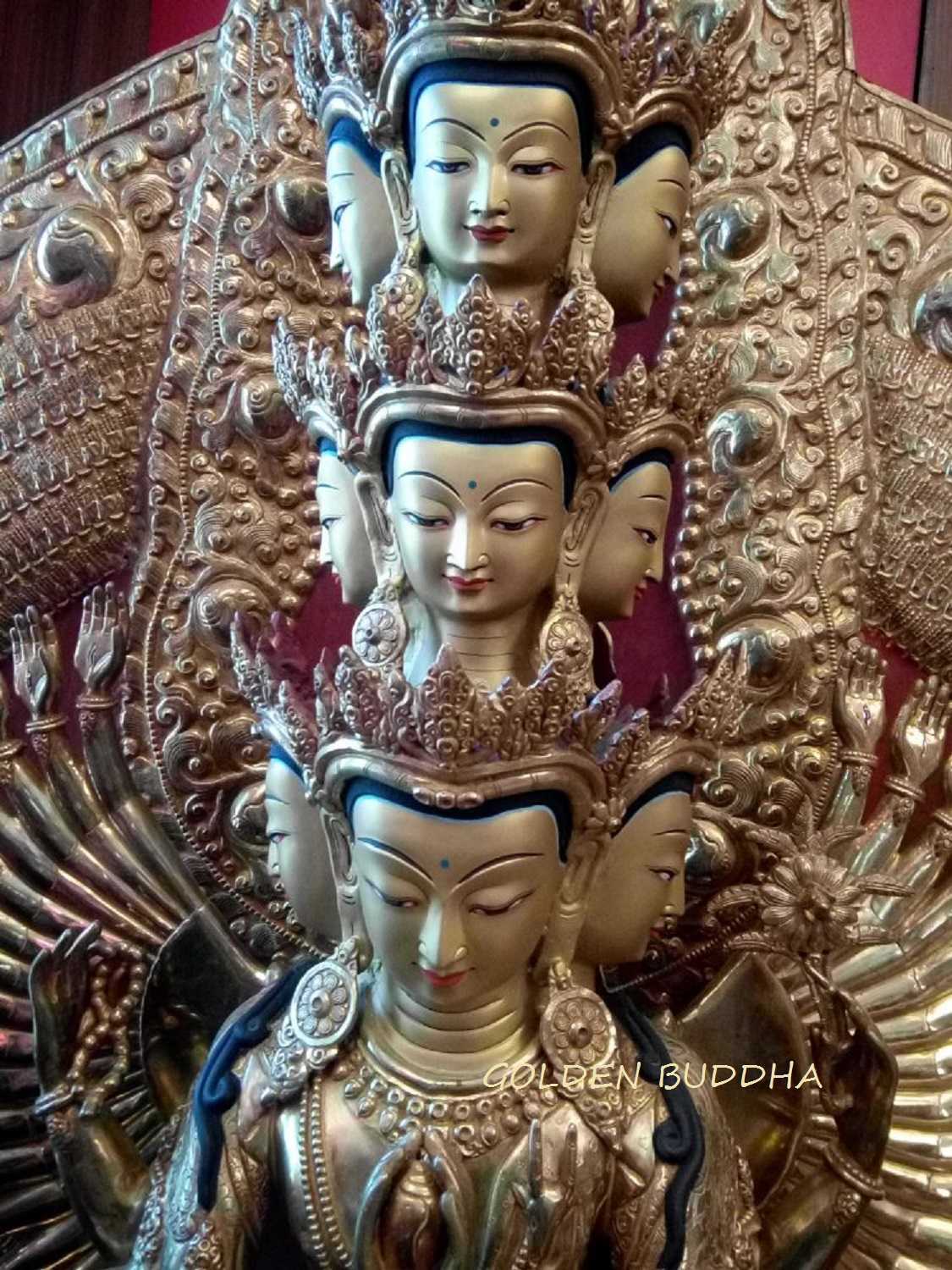
On the palm of each of Avalokiteshvara’s 1000 hands is an eye — symbolizing the joining of the five method perfections (the five fingers) with the sixth perfection of wisdom (the eye). Together, eyes and hands communicate that true compassion in action must be guided by wisdom — seeing clearly before acting, and acting skillfully to genuinely relieve suffering rather than perpetuate it.
Avalokiteshvara in Tibetan Buddhism — Chenrezig
When the Tibetan king Songtsen Gampo made Buddhism the national religion of Tibet in the 7th century CE, Avalokiteshvara — known in Tibetan as Chenrezig (སྤྱན་རས་གཟིགས།) — became the patron Bodhisattva of Tibet and one of the most universally worshipped figures in the entire Himalayan Buddhist world. The name Chenrezig is often translated as “the one who perceives the cries of the world” — a precise description of his compassionate function.
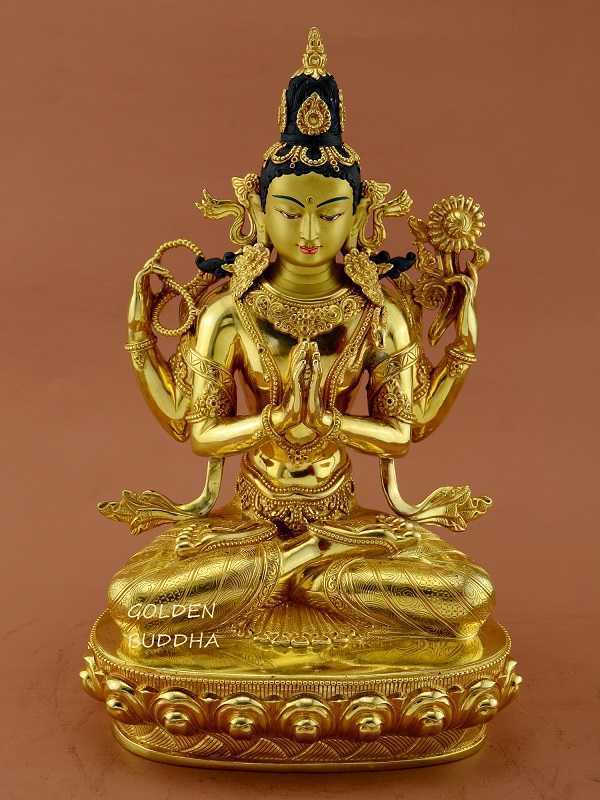
The standard Chenrezig statue in Tibetan Buddhist art is the four-armed form — each arm representing one of the four immeasurables: compassion (karuna), loving kindness (metta), equanimity (upekkha), and appreciative joy (mudita). These four qualities together constitute the complete range of enlightened loving awareness directed toward all sentient beings without exception. His iconographic attributes are precise:
- Upper right hand — holds a crystal mala of 108 beads, which he constantly rotates while reciting Om Mani Padme Hum on behalf of all sentient beings.
- Upper left hand — holds a lotus blossom, the universal Buddhist symbol of purity and enlightenment arising from the muddy waters of samsara.
- Lower two hands — pressed together at the chest holding the cintamani (“wish-fulfilling jewel”), which represents the enlightened mind capable of granting every wish of sentient beings.
- White body — representing the purity of compassion, untainted by self-interest or partiality.
Tibetan Buddhists believe that the 14th Dalai Lama is a living human incarnation of Chenrezig — making the Dalai Lama both a political leader of the Tibetan people and a living embodiment of the Bodhisattva of Compassion. Avalokiteshvara also has wrathful emanations: Hayagriva (“Horse-Necked One”) with 6 arms and 3 faces, and Black Mahakala with one face and six arms — both protector deities who act with fierce compassion to remove powerful obstacles to practice.
Four Armed Chenrezig Statue
Om Mani Padme Hum — The Chenrezig Mantra
Om Mani Padme Hum is the mantra of Avalokiteshvara — the most widely recited mantra in all of Buddhism. It is inscribed on prayer wheels, carved into mani stones lining mountain paths, and recited continuously by millions of practitioners across Tibet, Nepal, Bhutan, and wherever Tibetan Buddhism is practiced. Chenrezig is depicted in statues constantly rotating a mala of 108 beads — reciting this mantra uninterruptedly on behalf of all sentient beings.
“Om Mani Padme Hum”
The Om Mani Padme Hum meaning is among the most discussed and debated topics in popular Buddhism. The literal translation — “Om, the jewel in the lotus, hum” — only scratches the surface of its depth. The Dalai Lama’s authoritative explanation of the six syllables is the most widely cited in Tibetan Buddhist teaching:
Om Mani Padme Hum Meaning Explained
OM — A syllable with roots reaching back thousands of years into Vedic tradition — comparable to “Amen” in Christian prayer. The Dalai Lama explains that phonetically, Om breaks into three letters: A-U-M. These three letters simultaneously symbolize the practitioner’s impure body, speech, and mind — and the pure body, speech, and mind of the Buddha. Nobody is born with pure body, speech, and mind — including Buddhas. However, everybody can attain them through practice.
MANI — Sanskrit for “jewel.” The syllables of Mani constitute the factors of “method” — specifically the altruistic desire to achieve enlightenment (bodhichitta). The altruistic objective is not personal enlightenment alone but the aspiration to become enlightened so that all other sentient beings may also become enlightened.
PADME — Sanskrit for “lotus,” symbolizing wisdom. Specifically, the wisdom of realizing the true nature of all phenomena — their impermanence, unsatisfactoriness, and insubstantiality (no-self). Acquiring this wisdom is essential in order to realize the emptiness (sunyata) of all phenomena — the deepest insight in Mahayana Buddhist philosophy.
HUM — Symbolizes the indivisible unity of method and wisdom. Their indivisibility is imperative: compassionate method without wisdom becomes mere sentiment; wisdom without compassionate method becomes cold intellectualism. Together — as HUM — they constitute the path to enlightenment itself.
The Path to Enlightenment in Six Syllables
When the six syllables are recited together — Om Mani Padme Hum — they express the complete path: by using the indivisible unity of method (compassion, altruistic aspiration) and wisdom (insight into emptiness), sentient beings can purify their body, speech, and mind and attain Buddhahood. His Holiness the Dalai Lama reemphasizes in his commentary that, in the teachings of Maitreya Buddha: “All beings naturally have the Buddha nature in their own continuum.” We do not need to create it — we need only to develop and reveal it.
Tibetan Avalokiteshvara Statue

Masculine Origin of Avalokiteshvara
In the original Indian Buddhist tradition, Avalokiteshvara’s compassion is a masculine attribute. In contrast, wisdom is a feminine attribute in Buddhist philosophy. It is the primordial union of these two qualities — compassion (skillful means) and wisdom — that constitutes supreme enlightenment. The Buddhist symbol that represents compassion and skillful means is the vajra (thunderbolt scepter), while the ghanta (ritual bell) symbolizes the feminine aspect of wisdom. Together they are carried by deities such as Vajrasattva to represent this inseparable union.
For thousands of years the vajra represented power and strength across the Indian subcontinent. In ancient India, army commanders carried the vajra into battle as both weapon and symbol of authority. The guardian deity Indra also wielded the vajra as a mystical weapon in Vedic mythology — establishing its association with masculine force long before Buddhism adopted and transformed its meaning into one of spiritual power and indestructible wisdom.
Male Avalokiteshvara Statues — Theravada & Cambodia
Tibetan Buddhism is not the only tradition that perceives compassion as masculine. In countries where Theravada Buddhism is the national religion — including India, Sri Lanka, and Cambodia — compassion remains a masculine attribute and Avalokiteshvara is depicted in male form.
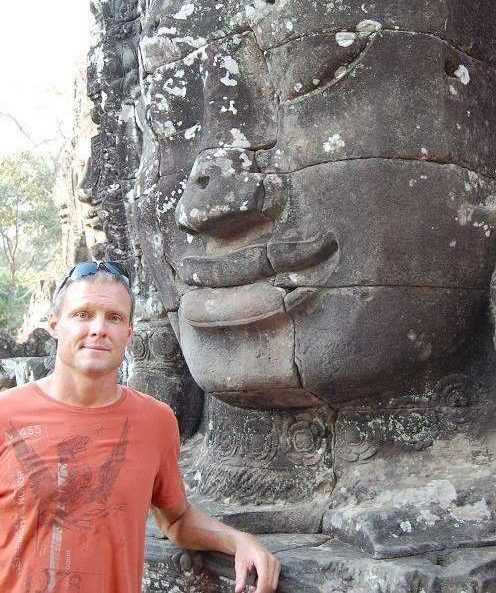
The most spectacular expression of this tradition is found in Cambodia, where the Khmer Empire referred to Avalokiteshvara by the name Lokesvara (“Lord of the World”) and built over 200 Lokesvara statues at the ancient Bayon Temple within the Angkor Thom complex — one of the most remarkable religious construction projects in human history. Each face at Bayon is believed to portray Lokesvara/Avalokiteshvara with a characteristic gentle smile — a smile now iconic in Khmer art — radiating compassionate awareness in all four cardinal directions simultaneously.
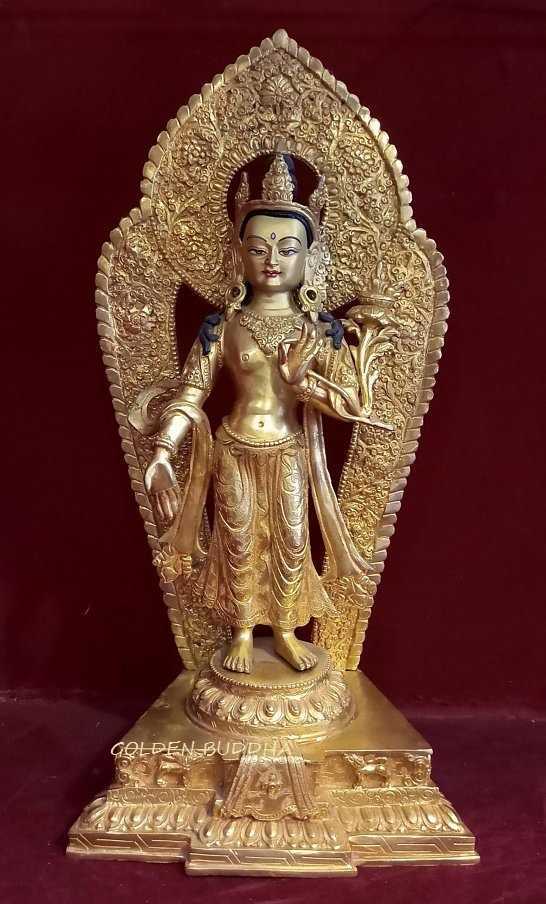
Standing Avalokiteshvara Statue
The Bayon Temple was completed in the 13th century CE during the reign of King Jayavarman VII — the most prolific builder in Khmer history, who converted the empire from Hinduism to Mahayana Buddhism. Although the Khmer Empire subsequently fluctuated between Hinduism and Buddhism, all 200 Lokesvara statues at Bayon remain standing today — each bearing the same characteristic compassionate smile, one of the most recognizable artistic signatures in all of Southeast Asian art. Read about my travels to Bayon and the ancient Angkorian Temples.
Female Avalokiteshvara — Guanyin in East Asia
As Buddhism traveled eastward during the first millennium CE and gained popularity in China, the Avalokiteshvara story crossed some of Asia’s most established cultural boundaries. Chinese culture has historically associated compassion with the female sex, not the male — and as a result, the embodiment of compassion underwent a dramatic transformation. In China, Avalokiteshvara became distinctly female and acquired the name Guanyin (觀音) — meaning “The One Who Perceives the Sounds (Cries) of the World.” This is a direct translation of the Sanskrit name Avalokiteshvara.
Guanyin quickly became one of the most beloved religious figures in all of East Asian culture — revered not only by Buddhists but by Taoists and folk practitioners alike. Korea adopted her as Gwan-eum, Japan as Kannon (or Kwannon) — each tradition adding its own cultural nuances while preserving the essential quality of compassionate responsiveness to suffering. Today Guanyin statues are found throughout China, Taiwan, Vietnam, Korea, and Japan — in temples, restaurants, businesses, homes, and roadside shrines.

Special Attributes of Guanyin Statues
Guanyin statues in China commonly depict her holding a white vase filled with special water called the “Dew of Compassion” (Ganlu in Chinese) — a sacred liquid with healing properties that she freely dispenses to relieve suffering and prolong life. In her other hand she typically holds a willow branch between her index finger and thumb. The willow branch is used to sprinkle the Dew of Compassion and is also understood to cure sickness and fulfill the wishes of her devotees — much as the Varada mudra (gift-giving gesture) functions in Indian and Tibetan Buddhist iconography.
The most popular Guanyin statue form depicts her in flowing white robes — standing, seated on a lotus, or riding a dragon — radiating serene compassion. White represents her purity and the clarity of her compassionate intention. Some forms depict her with a child, representing her role as a protector of mothers and children and a granter of offspring. The Chinese idiom “as compassionate as Guanyin” (Guanyin pusa) has entered everyday language as the highest compliment for human kindness.
Taoist Influence on Guanyin Statues in China
In some regions of China, the Guanyin tradition is rooted primarily in Taoism rather than Buddhism. In these areas, Guanyin is female not because of the Buddhist doctrine of skillful means, but because of her affiliation with the Taoist pantheon — specifically her identification with He Xian’gu, the only female member of the eight Taoist immortals. He Xian’gu lived during the Tang Dynasty (618–907 CE) and is associated with the lotus flower, purity, and spiritual cultivation. This Taoist origin explains why in parts of China, Guanyin’s compassion is not the central theme — instead, she functions more as a wish-fulfilling deity of fortune, health, and long life.
Despite this divergence, the Buddhist and Taoist streams of the Guanyin tradition have largely merged in popular Chinese religious practice — where devotees freely blend Buddhist mantra recitation with Taoist ritual in their veneration of Guanyin. There are also many Chinese Guanyin paintings and statues that portray her in the full 1000-armed, 11-headed form — a direct adoption from the Tibetan Chenrezig iconography — demonstrating that the two great streams of the Avalokiteshvara tradition have influenced and enriched each other throughout their long shared history.
Frequently Asked Questions About Avalokiteshvara
What does an Avalokiteshvara statue represent?
An Avalokiteshvara statue represents the Bodhisattva of Compassion — the embodiment of the compassion of all the Buddhas in a single form. Every iconographic element communicates his compassionate function: the 1000 arms reach simultaneously to every being in need; the eye on each palm represents wisdom guiding compassionate action; the 11 heads perceive suffering in every direction; the mala of 108 beads indicates constant mantra recitation on behalf of all sentient beings; the lotus represents purity of motivation; and the cintamani jewel represents the capacity to fulfill every wish of practitioners. Placing an Avalokiteshvara statue in a home altar or meditation space serves as a visual reminder to cultivate compassion as a daily practice.
What does Om Mani Padme Hum mean?
Om Mani Padme Hum is the six-syllable mantra of Avalokiteshvara (Chenrezig), the Bodhisattva of Compassion. The literal translation is “Om, the jewel in the lotus, hum.” The deeper meaning, as explained by the Dalai Lama, is a complete path to enlightenment encoded in six syllables: Om represents the aspiration to transform impure body, speech, and mind into the pure body, speech, and mind of a Buddha. Mani (jewel) represents the method — altruistic compassionate aspiration (bodhichitta). Padme (lotus) represents wisdom — the insight into the emptiness of all phenomena. Hum represents the indivisible unity of method and wisdom. Together: by practicing compassionate method and wisdom inseparably, sentient beings can attain Buddhahood.
What is the difference between Avalokiteshvara, Chenrezig, and Guanyin?
Avalokiteshvara, Chenrezig, and Guanyin are three names for the same Bodhisattva of Compassion in three different traditions. Avalokiteshvara is the original Sanskrit name used in Indian, Nepalese, and Tibetan Buddhist texts. Chenrezig is the Tibetan name — translated as “the one who perceives the cries of the world” — depicting a four-armed white male Bodhisattva with mala beads, lotus, and cintamani jewel. Guanyin is the Chinese name (also meaning “perceiver of sounds/cries”) — depicted as an elegant female in white robes, holding a vase of Dew of Compassion and a willow branch. All three represent the same quality of boundless compassion for all sentient beings.
Why does Avalokiteshvara have 1000 arms and 11 heads?
According to Buddhist tradition, Avalokiteshvara’s body imploded into pieces when he was overwhelmed by the immensity of his compassion vow and the stubborn ignorance of the beings he was trying to liberate. Amitabha Buddha reassembled him and granted him 1000 arms so he could simultaneously reach every suffering being in every direction, and 11 heads so he could perceive suffering in all directions and dimensions at once. Each of the 1000 hands has an eye in the palm — representing the union of the five method perfections (fingers) with the sixth perfection of wisdom (eye) — expressing that genuine compassionate action must be guided by wisdom to be truly effective.
Who is Avalokiteshvara in Tibetan Buddhism?
In Tibetan Buddhism, Avalokiteshvara (Chenrezig) is the patron Bodhisattva of Tibet — chosen as such when King Songtsen Gampo made Buddhism the national religion in the 7th century CE. He is considered a fully enlightened being (in some Tibetan schools) who has chosen to remain in samsara out of compassion for all beings until universal liberation is achieved. The 14th Dalai Lama is believed to be his human incarnation. He is accompanied in the Tibetan Buddhist trinity of principal Bodhisattvas by Manjushri (wisdom) and Vajrapani (power) — the three together representing the complete qualities of an enlightened mind.
Are Avalokiteshvara statues from Nepal authentic?
The artisan city of Patan (Lalitpur) in Nepal has been the world center for handcrafted Himalayan Buddhist statuary for over a thousand years — and Avalokiteshvara statues from Nepal produced by the traditional shakya craftsmen of Patan are among the finest Buddhist art objects in the world. Each statue is created using the traditional lost-wax casting (cire perdue) method, finished with 24K fire gilding and hand face painting using real gold. Every statue is certified by the Department of Archaeology in Kathmandu, and consecration (rabne) at a recognized Kathmandu monastery is available upon request — activating the statue as a genuine object of devotional practice.