

Vajrasattva statues depict Dorje Sempa, the “Vajra Being” or “Vajra Hero,” one of the most important purification deities in Tibetan Vajrayana Buddhism. Vajrasattva appears as a peaceful, richly adorned figure holding a vajra at his heart and a ritual bell at his left hip. These two implements express the inseparability of enlightened method and wisdom, while his luminous appearance represents the purity of awakened mind. Vajrasattva practice is especially associated with confession, purification of harmful actions and obscurations, restoration of damaged samaya commitments, and preparation for more advanced Vajrayana practice.[1]
Vajrasattva is not confined to a single doctrinal role. Indian and Tibetan tantric traditions present him as a Buddha, Bodhisattva, meditational deity and embodiment of the vajra nature of awakening. In Nyingma traditions he is additionally prominent in Dzogchen lineage accounts, while a distinctive relationship connects peaceful Vajrasattva with Vajrakilaya, the extremely wrathful deity of enlightened activity. This guide to Vajrasattva statues explores his history, meaning, iconography, mantra practice, sambhogakaya associations, yab-yum forms, relationship with Vajrapani, and the important peaceful-and-wrathful relationship between Vajrasattva and Vajrakilaya.
Contents
- What Is Vajrasattva? Dorje Sempa and the Buddha of Purification
- Vajrasattva Statues — Indian Origins and Himalayan History
- Vajrasattva, Sambhogakaya and the Trikaya
- Vajrasattva in Dzogchen and the Nyingma Lineage
- Vajrasattva Statues — Meaning and Symbolism
- Vajrasattva Statues — Vajra, Bell and Royal Ornaments
- Vajrasattva Mantra and the Four Powers of Purification
- The 100-Syllable Vajrasattva Mantra and Ngöndro
- Vajrasattva Statues and Vajrakilaya — Peaceful and Wrathful Forms
- Vajrasattva and Vajrakilaya Statue Pair
- Vajrasattva Yab-Yum and Vajragarvi
- Vajrasattva and Vajrapani — Why the Names Are Sometimes Confused
- Frequently Asked Questions About Vajrasattva Statues
- References and Doctrinal Sources
What Is Vajrasattva? Dorje Sempa and the Buddha of Purification
Vajrasattva is Sanskrit for “Vajra Being,” while his Tibetan name Dorje Sempa carries the same basic meaning. Vajra originally referred to the thunderbolt weapon of the Indian god Indra and later became one of the defining symbols of Vajrayana Buddhism, expressing indestructibility and the unshakable nature of awakened realization. Sattva means “being” and, in Buddhist compounds such as bodhisattva, can also carry the sense of a courageous or heroic being. The older translation “Diamond Being” captures the indestructible quality associated with the vajra, but “Vajra Being” is the more literal rendering.[2]
Across Tibetan traditions, Vajrasattva is especially important as a deity of purification. His meditation and mantra are used for confessing harmful actions, purifying obscurations and repairing damaged tantric commitments. Himalayan Art Resources describes purification as Vajrasattva’s primary universal function, while also noting that he appears in distinct meditational-deity forms within both the Sarma and Nyingma traditions.[1]
13-inch Tibetan Vajrasattva — Vajra Being and Buddha of Purification

Vajrasattva Statues — Indian Origins and Himalayan History
Vajrasattva is not a deity created in Tibet. His origins lie in Indian Esoteric Buddhism, where he appears in important tantric systems and ritual literature. An eighth-century Kashmir sculpture now preserved by The Metropolitan Museum of Art already depicts Vajrasattva holding the vajra and bell, demonstrating that his familiar iconography was established in the Indian Buddhist world many centuries before the later flourishing of Tibetan Buddhism.[3]
Vajrasattva also occupies an important place within the Yoga Tantras. Himalayan Art identifies the solitary “Universal Ruler” form as arising from Yoga Tantra, while later Sarma traditions preserve Vajrasattva with consort in Anuttarayoga Tantra, including a form known as Heruka Vajrasattva. Nyingma traditions developed numerous additional Kama and Terma cycles in which Vajrasattva functions both as a purification deity and as a major meditational deity.[1]
Nepal also has a long historical relationship with Vajrasattva imagery. A refined fourteenth-century Nepalese Vajrasattva preserved by the Rubin Museum demonstrates the continuity of the deity’s vajra-and-bell iconography within Newar Buddhist metalwork. The Kathmandu Valley subsequently became one of the principal centers supplying Buddhist images to Tibet and the wider Himalayan region. Modern images in our Vajrasattva collection handmade in Nepal continue this sophisticated metal-casting tradition, while their precise iconography ultimately derives from much older Indian and Himalayan sources.[4]
Vajrasattva Statues, Sambhogakaya and the Trikaya
The doctrine of the three bodies, or trikaya, explains different dimensions through which Buddhahood is understood. The dharmakaya is the ultimate or truth dimension of awakening, beyond ordinary form. The sambhogakaya, often translated as the “enjoyment body,” appears in magnificently adorned forms associated with pure realms and advanced Bodhisattvas. The nirmanakaya, or emanation body, refers to manifestations appearing within ordinary worlds, with Shakyamuni Buddha being the classic example.
Vajrasattva’s jeweled crown, necklaces, silks and princely ornaments correspond naturally with sambhogakaya-style Buddhist iconography. Yet it is better not to reduce every Tibetan interpretation to the simple equation “Vajradhara equals dharmakaya and Vajrasattva equals sambhogakaya.” Himalayan Art describes Vajrasattva as the inner form of primordial Vajradhara and as representing the Buddha families, while particular Nyingma Dzogchen lineages employ a different but related three-body formulation.[1]
Vajrasattva in Dzogchen and the Nyingma Lineage
Vajrasattva has a particularly important place in traditional Nyingma accounts of the Dzogchen transmission. Several lineage prayers identify Samantabhadra as dharmakaya, Vajrasattva as sambhogakaya, and Garab Dorje as the human or nirmanakaya manifestation through whom the teachings entered the human world. The Khandro Nyingtik lineage history likewise describes Samantabhadra transmitting by blessing to Vajrasattva, who then instructed Garab Dorje.[5]
This does not mean that Vajrasattva should simply be called “the primordial source of all Dzogchen” without qualification. Samantabhadra occupies the dharmakaya position at the beginning of these traditional lineages, with Vajrasattva functioning as the sambhogakaya transmitter and Garab Dorje as the first human master. This more precise lineage description preserves Vajrasattva’s elevated role without obscuring the distinct functions assigned to Samantabhadra and Garab Dorje.
Vajrasattva Statues — Meaning and Symbolism
The meaning of a Vajrasattva statue begins with the vajra itself. In Indian tradition the vajra was a thunderbolt weapon, while in Buddhist tantra it became a central symbol for indestructibility, stability and awakened realization. Vajrasattva personifies this vajra quality. The Rubin Museum describes him as both an accomplished Bodhisattva and primordial Buddha who is invoked for purification and as the personification of the vajra principle itself.[4]
For practitioners, the deity therefore represents something deeper than moral cleansing in an ordinary sense. Vajrasattva purification works within the Buddhist framework of karma, confession, resolve and the recognition that obscurations are removable rather than intrinsic to awakened mind. The image provides a visual support for contemplating purity, restoring commitments and approaching one’s practice with renewed clarity.

Vajrasattva Statues — Vajra, Bell and Royal Ornaments
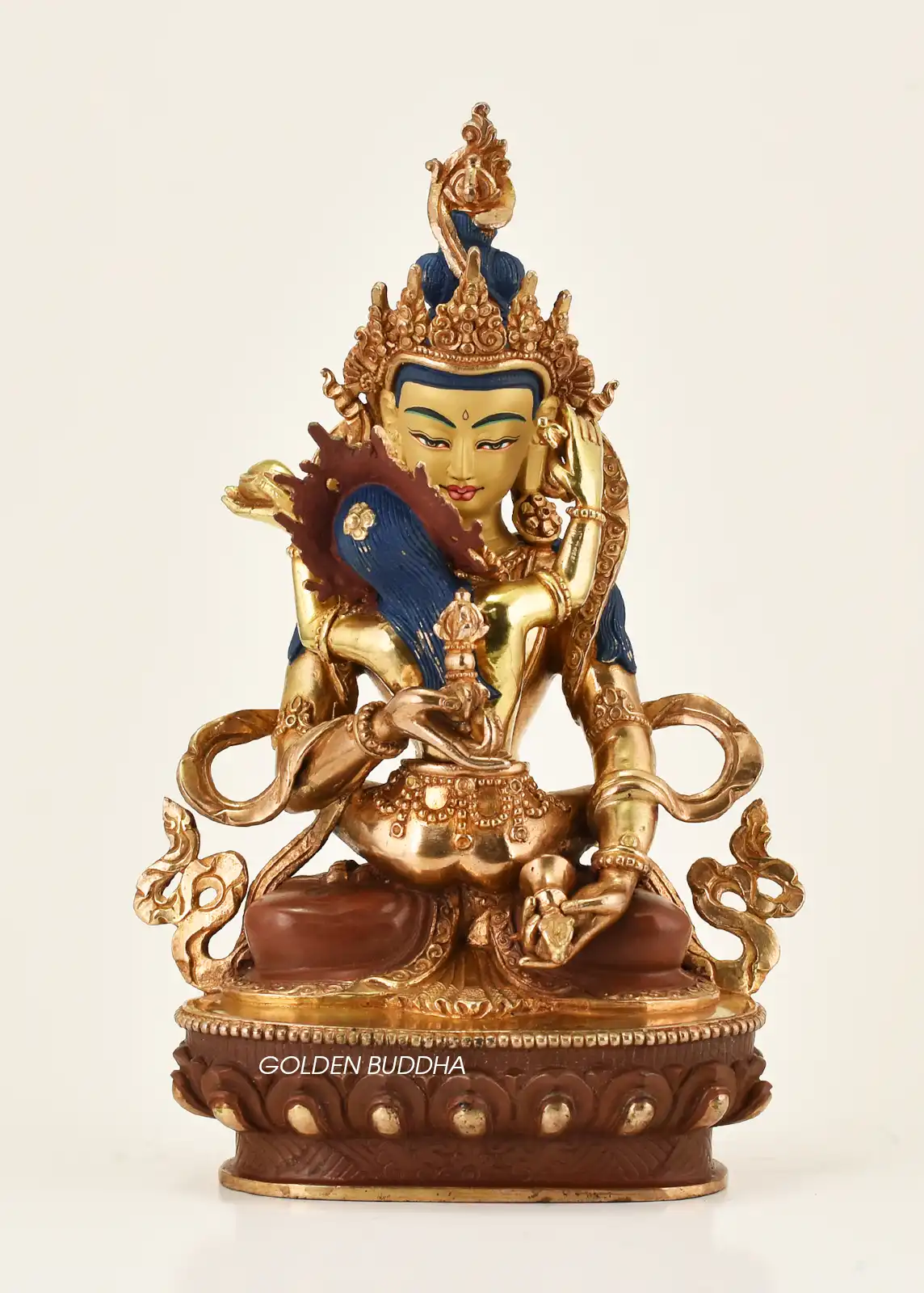
The peaceful solitary form of Vajrasattva is generally described as white in ritual visualization, although metal sculptures may naturally appear gold, copper or another finish. He has one face and two arms and usually sits in vajra posture upon a lotus and moon disc. His right hand holds a vajra upright at the heart, while his left holds a vajra-handled ghanta, or bell, at the hip. These attributes have remained remarkably stable across Indian, Nepalese and Tibetan representations.[3]
The vajra generally represents method, compassionate activity and the indestructible nature of enlightenment. The bell generally represents wisdom and emptiness. When paired, the two ritual objects express the inseparability of method and wisdom. Specific tantric cycles provide more detailed symbolic explanations for individual prongs, lotus petals and other parts of the implements, so it is better not to insist that every five-pronged vajra always carries only one fixed symbolic interpretation.[6]
Royal ornaments distinguish Vajrasattva visually from the simple monastic appearance of Shakyamuni Buddha. A crown, earrings, necklaces, armlets, bracelets, anklets and flowing silks belong to the visual vocabulary of peaceful tantric and sambhogakaya deities. These ornaments communicate the splendor of awakened qualities rather than worldly kingship.
Vajrasattva Mantra and the Four Powers of Purification
Vajrasattva mantra practice is one of the most widespread methods of purification in Tibetan Buddhism. A common short form is the six-syllable mantra:
Oṃ Vajrasattva Hūṃ
Although written as three words in Roman letters, the Sanskrit formula is traditionally counted as six syllables. Rather than assigning speculative universal meanings to each syllable, practitioners generally rely on the interpretation transmitted within their own lineage. The short mantra and the longer hundred-syllable formula both occur in Tibetan practice literature.[7]
Traditional Vajrasattva purification is commonly structured around the four powers: reliance or support, sincere regret for harmful actions, resolution not to repeat them, and the application of an antidote or remedy. In Vajrasattva practice the remedy includes visualization and mantra recitation. The point is not merely to repeat a sacred formula mechanically, but to combine recitation with ethical acknowledgment, resolve and a transformed relationship to one’s actions.[8]
The 100-Syllable Vajrasattva Mantra and Ngöndro
The hundred-syllable Vajrasattva mantra is one of the best-known confession and purification formulas in Tibetan Vajrayana. It occupies a central place in many ngöndro, or preliminary-practice systems. The precise structure of ngöndro is not identical in every Tibetan school or lineage, however, so it is more accurate to say that Vajrasattva is extremely widespread among Tibetan preliminary practices rather than describing one fixed four-part curriculum as universal.
Many traditional ngöndro programs prescribe large accumulations of the mantra, frequently 100,000 recitations or more, while other Vajrasattva liturgies establish different numbers. The count therefore belongs to the particular practice text and teacher rather than constituting an absolute rule for every Buddhist practitioner.[7]
A widely transmitted Tibetan phonetic form of the hundred-syllable mantra is:
Om Vajrasattva Samaya Manu Palaya / Vajrasattva Deno Pa Tishtha / Dridho Me Bhava / Suto Kayo Me Bhava / Supo Kayo Me Bhava / Anu Rakto Me Bhava / Sarva Siddhi Me Pra Yatsa / Sarva Karma Su Tsa Me / Tsitam Shriyam Kuru Hum / Ha Ha Ha Ha Ho / Bhagawan / Sarva Tatagata / Vajra Ma Me Mu Tsa / Vajri Bhava Maha Samaya Sattva / Ah Hum Pey
Pronunciation and Romanized spelling vary between Tibetan lineages. In many ngöndro instructions Vajrasattva is visualized above the practitioner’s head, sometimes alone and sometimes united with his consort according to the specific lineage. White nectar descends from the deity and is visualized as purifying harmful actions, obscurations and breaches of commitment. Patrul Rinpoche’s ngöndro instructions explicitly combine this visualization with the hundred-syllable mantra and the four powers.[8]
Vajrasattva Statues and Vajrakilaya — Peaceful and Extremely Wrathful Forms
One of the most fascinating relationships within Nyingma Buddhism connects peaceful Vajrasattva with Vajrakilaya, Sanskrit Vajrakīlaya or Vajrakīla, Tibetan Dorje Phurba. Within Nyingma explanations of the Kagyé system, Vajrasattva is the peaceful expression of enlightened activity and Vajrakilaya is its extremely wrathful manifestation. Vajrakilaya embodies the awakened activity of the Buddhas directed toward overcoming inner and outer obstacles to Dharma practice.[9]
This peaceful-to-wrathful relationship should be understood within its specific tantric and Nyingma context rather than as a claim that every form called Vajrasattva universally transforms into Vajrakilaya in all Buddhist systems. Within the Kagyé enlightened-activity tradition, however, the connection is explicit: peaceful Vajrasattva expresses immaculate vajra nature, while Vajrakilaya manifests that same awakened nature through intensely forceful enlightened activity.
Vajrakilaya’s iconography makes the contrast immediately visible. Instead of Vajrasattva’s peaceful single face and two arms, Vajrakilaya commonly appears with three wrathful faces, six arms and four legs, often embracing the consort Diptachakra. His defining attribute is the phurba, or ritual vajra peg, held at the heart. Wings, wrathful ornaments and a blazing aureole amplify the image of enlightened activity confronting obstruction directly.[10]
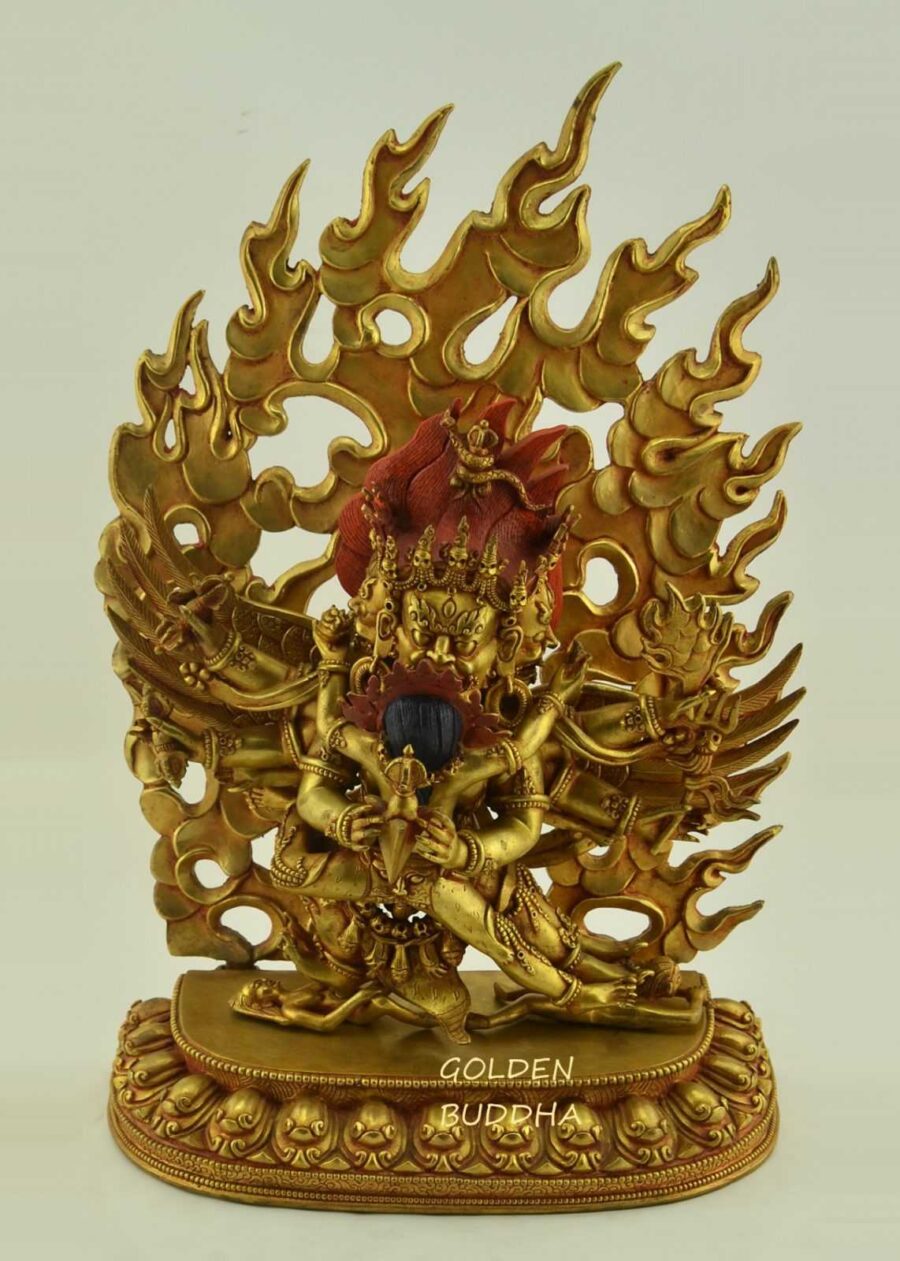
Vajrakilaya and Vajrasattva Statues Set — Peaceful Purity and Wrathful Activity
Our 14-inch gold gilded Vajrasattva statue and 16-inch handmade Vajrakilaya statue form one of the strongest peaceful-and-wrathful statue pairings in the Golden Buddha collection. Their doctrinal relationship is unusually direct. Vajrasattva represents purified vajra nature in serene form, associated with confession, purification and restoration of samaya. Vajrakilaya expresses the same awakened vajra principle through extremely wrathful enlightened activity directed toward cutting through obstacles and obstructive conditions.
The two statues are also exceptionally compatible aesthetically. Both are substantial handmade copper-alloy sculptures from Nepal finished with traditional 24K gold fire gilding. The 14-inch Vajrasattva is calm, symmetrical and richly jeweled, seated upon a lotus while holding the vajra and bell. The 16-inch Vajrakilaya rises within a removable flame aureole, multiplying the composition into wrathful faces, arms, wings, ritual implements and yab-yum imagery. Their related scale and luminous gold surfaces create visual continuity, while their radically different expressions provide a deliberate peaceful-versus-wrathful balance.
Displayed together, the pairing illustrates an important Vajrayana principle: peaceful purification and wrathful enlightened activity are not opposites in the ordinary sense. Both are directed toward liberation from obscuration. One reveals purity through confession, restoration and clarity; the other confronts entrenched obstacles with uncompromising awakened activity. This makes the pair meaningful for practitioners familiar with the relevant traditions and equally valuable for collectors seeking a visually coherent presentation of peaceful and wrathful Himalayan Buddhist art.
Vajrasattva Yab-Yum and Vajragarvi
Vajrasattva also appears in union with a consort. Himalayan Art identifies the consort as Vajragarvi, Tibetan Dorje Nyema, and also gives the name Vajradhatvishvari in particular traditions. Vajrasattva remains white, holding the vajra at the heart and bell at the hip, while the consort sits in his lap and embraces him. Attributes can differ according to the individual cycle; in commonly documented examples she holds a skull cup.[11]
The yab-yum image expresses the inseparability of complementary dimensions of awakening, conventionally explained as method and wisdom. It should therefore not be interpreted as an ordinary romantic or erotic scene. In Sarma traditions, Himalayan Art traces the consort form known as Heruka Vajrasattva to Anuttarayoga Tantra, while Nyingma traditions preserve their own Vajrasattva-with-consort visualizations and ritual cycles.[1]
Vajrasattva and Vajrapani — Why the Names Are Sometimes Confused
Vajrapani and Vajrasattva should not simply be treated as interchangeable deities. Vajrasattva proper has a well-established peaceful iconography centered on the vajra and bell and an especially important purification function. Vajrapani has his own extensive history as a Bodhisattva and tantric deity associated with the power of the Buddhas.
The confusion arises because vajrasattva, literally “vajra being,” can also function as a descriptive title in Esoteric Buddhist texts. The 84000 glossary notes that the term may be applied to other tantric deities, particularly Vajrapani. Historical sculptures can therefore sometimes be difficult to distinguish without examining the ritual attributes, lineage and textual context. This is very different from saying that every Vajrapani is simply another name for the peaceful purification deity Vajrasattva.[2]
Frequently Asked Questions About Vajrasattva Statues
What does a Vajrasattva statue represent?
A Vajrasattva statue represents the purifying and indestructible vajra nature of awakened mind. In the common peaceful form Vajrasattva holds a vajra at the heart and bell at the left hip. The vajra and bell generally express the inseparable relationship between enlightened method and wisdom.
What does the name Vajrasattva mean?
Vajrasattva literally means “Vajra Being.” Tibetan Dorje Sempa translates the same expression. “Diamond Being” and “Vajra Hero” are also useful interpretive translations. The name emphasizes the indestructible quality represented by the vajra rather than defining sattva as a special kind of spiritual energy.
What is the Vajrasattva mantra?
Two especially familiar forms are the short six-syllable Oṃ Vajrasattva Hūṃ and the traditional hundred-syllable mantra. The longer formula is particularly important in Tibetan purification and ngöndro practices. Pronunciation, visualization and required accumulations vary according to lineage.
What are the four powers of Vajrasattva purification?
The four powers are generally described as reliance or support, regret, resolution not to repeat the harmful action, and the application of a remedy or antidote. Vajrasattva visualization and mantra recitation function as the remedial aspect within this framework. Terminology may vary slightly between translations and traditions.
Is Vajrakilaya a wrathful form of Vajrasattva?
Yes, within important Nyingma explanations, especially the Kagyé enlightened-activity context, Vajrakilaya is described as an extremely wrathful manifestation of Vajrasattva. Peaceful Vajrasattva expresses the purity of vajra nature, while Vajrakilaya expresses awakened activity in a forceful form directed toward overcoming obstacles and obscurations.
Why do Vajrakilaya and Vajrasattva statues make a good pair?
The relationship is both doctrinal and visual. Vajrasattva and Vajrakilaya can represent peaceful purification and extremely wrathful enlightened activity arising from the same vajra nature. Our 14-inch Vajrasattva and 16-inch Vajrakilaya are also closely matched in scale, 24K gold fire-gilded finish and elaborate Nepalese craftsmanship, creating a balanced peaceful-and-wrathful statue pairing.
Is Vajrasattva the sambhogakaya of Vajradhara?
Some tantric explanations describe Vajrasattva as the inner form of Vajradhara, while Nyingma Dzogchen lineage prayers specifically identify Vajrasattva as the sambhogakaya figure between dharmakaya Samantabhadra and Garab Dorje. It is therefore better to present the sambhogakaya relationship within its particular doctrinal and lineage context rather than as a single universal equation used identically throughout Tibetan Buddhism.
Is Vajrasattva the same as Vajrapani?
No, not as a simple iconographic identification. Vajrasattva and Vajrapani have distinct forms and functions. However, the Sanskrit term vajrasattva can also be used descriptively for other tantric figures, including Vajrapani, which explains why some historical texts and artworks create apparent overlap between the names.
Does Vajrasattva practice always require 100,000 mantra recitations?
No. Many traditional ngöndro systems prescribe an accumulation of 100,000 hundred-syllable Vajrasattva mantras or comparable large numbers, but requirements vary by lineage and practice text. Practitioners should follow the instructions associated with their own teacher and transmission rather than treating one count as universal.
Can anyone own a Vajrasattva statue?
A Vajrasattva statue can be respectfully owned, displayed and studied as sacred Buddhist art. Requirements for specific visualizations, self-generation practices, empowerments and mantra commitments vary between lineages. Those undertaking formal Vajrayana practice should follow the instructions of a qualified teacher rather than assuming that every Vajrasattva liturgy has the same prerequisites.
References and Doctrinal Sources
- Himalayan Art Resources — Vajrasattva Religious Context. Describes Vajrasattva’s Indian origin, universal purification function, relationship with Vajradhara, solitary Yoga Tantra form, Sarma consort form and Nyingma Kama and Terma traditions.
- 84000: Translating the Words of the Buddha — Vajrasattva Authority Entry. Gives the Sanskrit and Tibetan forms of the name and the literal English rendering “vajra being.” See also 84000’s textual glossaries for the broader tantric use of vajrasattva as a title applied to other esoteric deities.
- The Metropolitan Museum of Art — The Bodhisattva Vajrasattva, Kashmir, 8th Century. An early Indian Vajrasattva sculpture holding the characteristic thunderbolt and bell, providing important evidence for the antiquity of the deity’s iconography.
- Rubin Museum of Himalayan Art — Vajrasattva. Describes Vajrasattva as an accomplished Bodhisattva and primordial Buddha invoked for purification and identifies the characteristic vajra and bell. The sculpture is a fourteenth-century Nepalese example.
- Lotsawa House — Khandro Nyingtik Lineage History. Describes dharmakaya Samantabhadra transmitting to sambhogakaya Vajrasattva, who then instructs Garab Dorje. See also Dodrupchen Jigme Tenpe Nyima’s Dzogchen Lineage Prayer, which explicitly identifies Samantabhadra as dharmakaya and Vajrasattva as sambhogakaya.
- Rubin Museum of Himalayan Art — Vajra and Bell Iconography. Explains the common Vajrayana symbolism of the vajra as method and the bell as wisdom. More detailed vajra-and-bell symbolism can vary according to individual tantric systems.
- Lotsawa House — Dudjom Tersar Ngöndro. Provides both the hundred-syllable Vajrasattva mantra and the six-syllable Oṃ Vajra Sattva Hūṃ, demonstrating their use within an established Nyingma preliminary-practice lineage.
- Lotsawa House — Patrul Rinpoche, Brief Guide to the Ngöndro Visualization. Describes Vajrasattva holding the vajra and bell, the hundred-syllable mantra, nectar purification visualization and practice with the four powers. See also Vajrasattva Meditation and Recitation for a detailed explanation of support, regret, resolution and remedial action.
- Lotsawa House — Introduction to Vajrakilaya. Identifies Vajrakilaya as a wrathful form of Vajrasattva and as the embodiment of the awakened activity of all Buddhas. Nyingma Kagyé explanations further describe peaceful Vajrasattva and extremely wrathful Vajrakilaya as related expressions of enlightened activity.
- Himalayan Art Resources — Vajrakilaya, Eight Pronouncements. Documents the characteristic three-faced, six-armed wrathful Vajrakilaya form with consort Diptachakra and provides an art-historical reference for the deity’s Nyingma Kagyé iconography.
- Himalayan Art Resources — Vajrasattva with Consort. Identifies the consort as Vajragarvi, also known in some traditions as Vajradhatvishvari, and documents Vajrasattva’s vajra, bell, peaceful appearance and yab-yum iconography.