



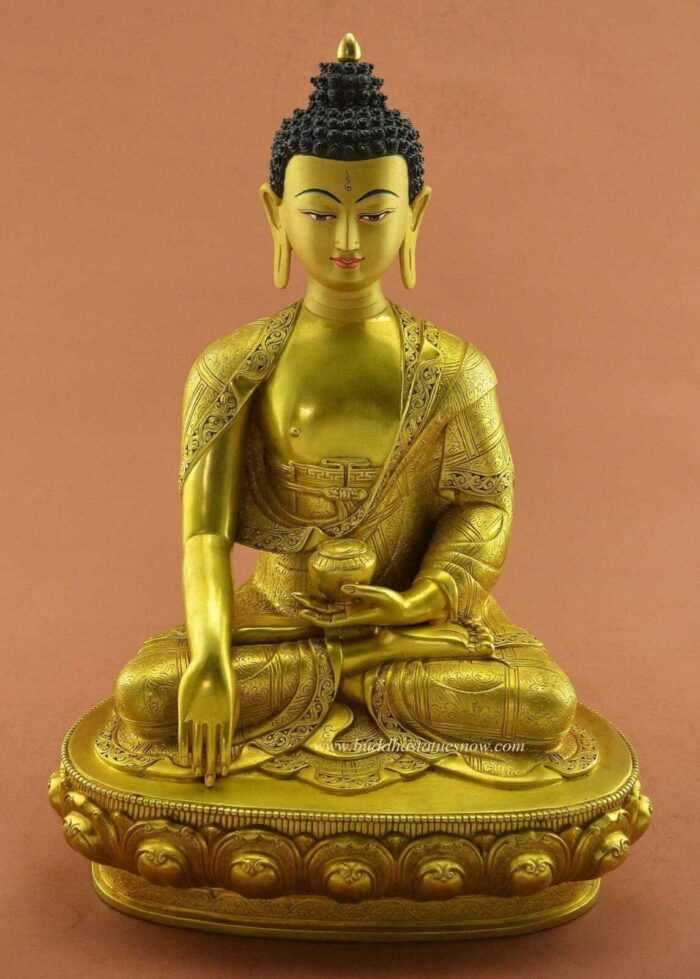
This exceptional 14.5″ Historical Buddha statue portrays Shakyamuni Buddha at the moment of his enlightenment beneath the Bodhi tree. Handcrafted from copper alloy by a master Newar artisan in Patan, Nepal, the sculpture was created through the traditional lost wax casting method and fire gilded in pure 24K gold. The face is separately hand painted with 18K gold and natural pigments, giving Shakyamuni a peaceful, lifelike expression framed by dark brows, softly outlined eyes, red lips, and tightly curled blue-black hair.
The artistic character of this Historical Buddha statue is defined by the contrast between the Buddha’s smooth, luminous chest and the extraordinary foliate engraving covering his monastic robes. A richly decorated shawl passes over both shoulders and descends across the torso, while an ornamental sash encircles the waist and gathers into a carefully modeled knot. Dense scrolling vines, stylized leaves, blossoms, and traditional Himalayan patterns continue across the lap, sleeves, robe borders, and the entire reverse of the garment. This extensive hand engraving transforms the statue into an especially refined example of sacred Newar metalwork while preserving the composed simplicity associated with the historical Buddha.
Historical Buddha Statue and the Earth-Touching Mudra
Shakyamuni displays the Bhumisparsha mudra, or earth-touching gesture, with his right hand extending over the knee and the fingers directed toward the ground. This is the defining gesture of the historical Buddha’s awakening. After years of spiritual searching and meditation, Siddhartha Gautama sat beneath the Bodhi tree at Bodh Gaya and resolved not to rise until he had discovered the cause of suffering and the path leading beyond it.
According to Buddhist tradition, Mara challenged Siddhartha’s right to attain enlightenment and demanded proof of the merit accumulated through his countless previous lives. Siddhartha touched the earth and called it to witness his spiritual accomplishments. The earth responded, affirming his merit and marking the defeat of Mara’s forces. The Bhumisparsha mudra therefore represents unshakable determination, victory over delusion, and the direct realization that transformed Siddhartha into Shakyamuni Buddha. Learn more about the meaning of the Bhumisparsha mudra in our complete guide to Shakyamuni iconography.
Alms Bowl and the Renunciation of Prince Siddhartha
His left hand rests in the lap in the Dhyana mudra, the gesture of meditation and inner equilibrium. A carefully modeled lidded alms bowl rests within the open palm. The bowl recalls Siddhartha’s Great Renunciation, when he left the privileges of palace life and adopted the simple existence of a wandering spiritual seeker. By accepting food freely offered by others, he relinquished royal wealth and devoted himself completely to discovering liberation from suffering.
In Buddhist art, the alms bowl may also be understood to contain the three nectars that counteract the three poisons of ignorance, attachment, and hatred. These afflictions are regarded as the underlying causes of harmful conduct and continued existence within samsara. The pairing of the meditation gesture and the earth-touching mudra unites the inward discipline that preceded enlightenment with the decisive moment in which awakening was realized and witnessed by the earth.
Marks of the Enlightened Historical Buddha
Several traditional physical attributes distinguish this sculpture as an image of a fully awakened Buddha. The urna appears between the brows as a mark of transcendent wisdom and enlightened vision. His elongated earlobes recall the heavy royal earrings worn during his youth as Prince Siddhartha, while also serving as a reminder that he abandoned worldly privilege in search of a permanent solution to suffering.
The tightly curled, right-turning hair rises into the ushnisha, a cranial protuberance symbolizing the extraordinary wisdom of Buddhahood. A small gilded finial crowns the topknot, while the three horizontal lines across the neck are included among the auspicious physical marks traditionally attributed to an enlightened being. The carefully painted eyes remain partly lowered, suggesting both profound meditation and compassionate awareness of sentient beings. Explore these attributes in greater detail in our guide to the physical characteristics of the Buddha.
Fine Foliate Engraving Across the Robes
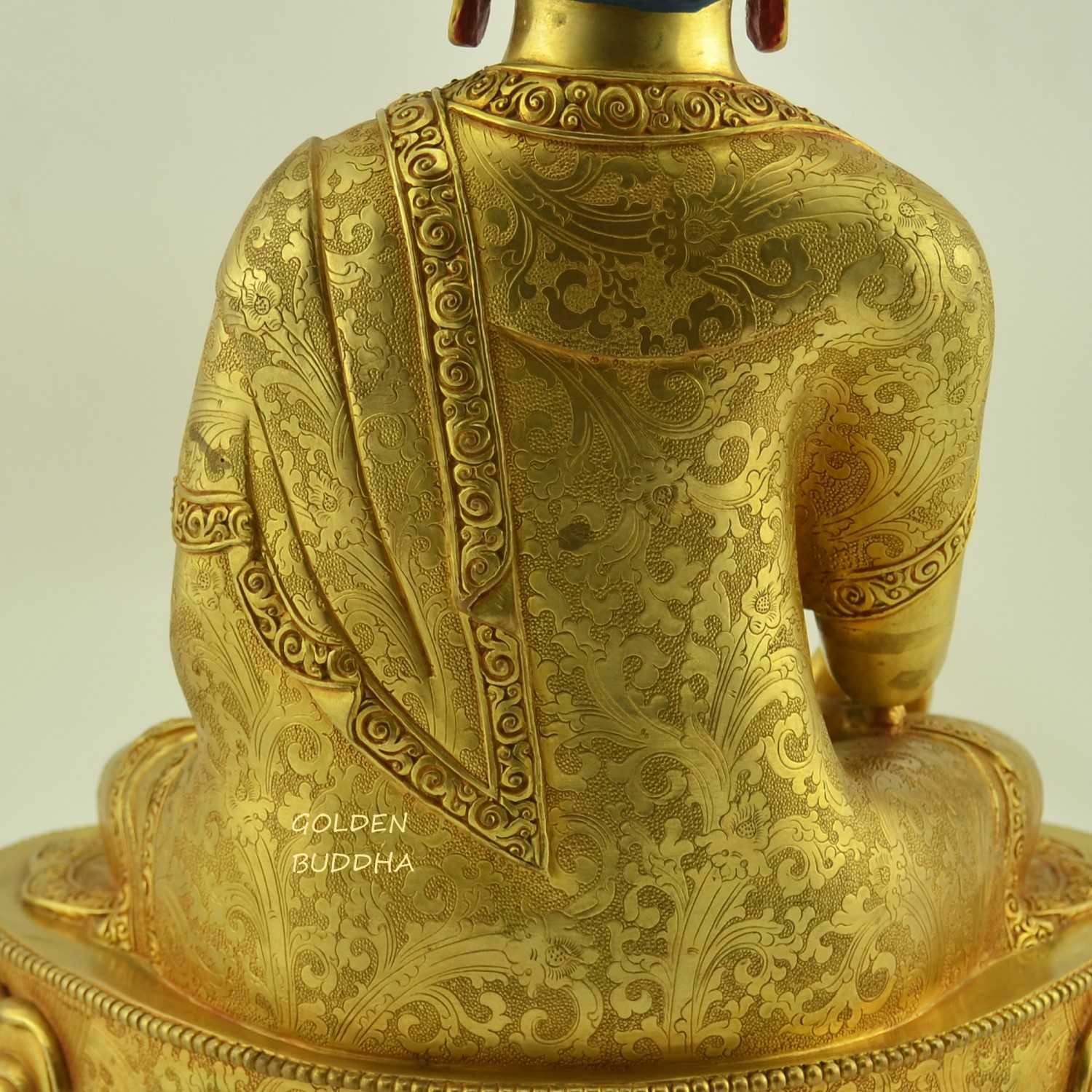
The elaborate robe is the most visually distinctive feature of this Historical Buddha statue. Fine foliate engraving covers the shoulder wrap, sleeves, sash, lap, and garment panels with a continuous arrangement of scrolling vines, stylized blossoms, leaves, and cloud-like forms. Raised borders filled with repeating scroll patterns define each section of the robe, separating the larger engraved fields and giving the garment a layered, textile-like appearance.
From the front, the shawl frames the Buddha’s polished chest before flowing diagonally across the body. The waist is secured by a broad ornamental band incorporating a geometric key-fret design and a central knotted tie. Across the folded legs, the engraved fabric gathers naturally into layered panels, combining realistic drapery with intricate surface decoration. The floral motifs remain closely spaced but do not obscure the sculpted form beneath them.
The craftsmanship becomes even more impressive when the statue is viewed from behind. Nearly the entire back of the robe is filled with finely chased foliate designs, including scrolling leaves, flowering vines, and symmetrical ornamental patterns. Engraving also continues along the neckline, robe borders, sleeve bands, and the lower garment covering the seated figure. This attention to the reverse makes the sculpture particularly suitable for an open shrine or display where it can be appreciated from several directions.
Single Lotus Pedestal with Engraved Ornamentation
Shakyamuni sits in the full lotus posture upon a substantial single lotus pedestal. A continuous row of rounded lotus petals surrounds the oval throne, symbolizing purity and the possibility of awakening within the conditions of samsara. Just as the lotus rises from muddy water without being stained, the Buddha attained complete enlightenment while living within the same conditioned world experienced by all sentient beings.
The pedestal is finished with more than a simple row of petals. The lower border contains a continuous engraved leaf pattern, while fine ornamental work decorates the base beneath and around the seated figure. On the reverse, dense foliate engraving continues across the broad central field of the pedestal, joined by a circular ornamental emblem and carefully chased borders. The repetition of leaf and floral designs connects the throne visually with the richly decorated robe above, producing a coherent composition from front to back.
Shakyamuni Buddha as the Historical Teacher
Shakyamuni Buddha was born as Siddhartha Gautama into the Shakya clan of ancient northern India. Although raised amid royal comfort, he became deeply troubled by the realities of aging, illness, and death. His search for a path beyond suffering led him to renounce palace life, study under accomplished meditation teachers, practice severe austerities, and eventually discover the balanced approach known as the Middle Way.
Following his enlightenment, Shakyamuni taught for approximately forty-five years, explaining the Four Noble Truths, dependent origination, ethical conduct, meditation, and the wisdom that realizes the nature of reality. A Historical Buddha statue does more than commemorate an important religious teacher; it represents the possibility that ignorance can be overcome through disciplined practice and direct insight. The image may serve as a focal point for meditation, refuge, offerings, or reflection upon the Buddha’s life and teachings. Further information about his iconography and history is available in our Shakyamuni Buddha statue FAQ.
Custom Made Historical Buddha Statues
Collectors, practitioners, monasteries, Dharma centers, and Buddhist organizations may commission a custom made Tibetan Buddhist statue based upon this Shakyamuni design. A custom Historical Buddha statue may be created in a different size with a traditional 24K fire-gilded finish, an oxidized copper surface, selective gilding, or an antiquated patina over the copper alloy casting. Each commission is handcrafted in Nepal through the lost wax process and completed according to traditional Himalayan iconographic proportions.
Customization may include especially detailed foliate engraving across the robe and pedestal, alternative garment patterns, a hand-painted face, adjusted lotus-petal designs, or ornamental borders selected to complement an existing shrine. Larger statues may be commissioned for monasteries, temples, meditation halls, or Dharma centers, while smaller versions can be created for personal altars and private collections. Because every sculpture is individually cast, carved, engraved, gilded, and painted by hand, a commissioned statue retains the distinctive character of traditional Newar craftsmanship rather than appearing mechanically reproduced.
Authentic, Handmade in Nepal
Every statue and ritual item is handcrafted in Patan, Nepal, using traditional lost wax casting and comes with a certificate of authenticity issued by Nepal's Department of Archaeology, verifying its materials, technique, and origin.
frankfreywis (verified owner) –
This statue is a very fine work. I am very happy with quality, the consecration and filling.
Best regards,
Frank